Filed under: Chicano, Los Angeles, Video, art | Tags: Alla, Eddie Martinez, Gary Garay, Josh Kun, Oscar Zeta Acosta
- Gary Garay, The Last Buffalo, 2004

About a month ago, a discussion on the Art and Music of Post-Mexico by Josh Kun at Boston’s ICA got our juices flowing. More than that, it gave us some considerable material to reflect upon, which we hope to share sooner or later on our pages here at tirado/thrown. We hope to do so once we have a some more developed reflections ready to go.
Among the trove of exquisite finds Kun shared with those in attendance was the work of Gary Garay, whose evocative work retrieves and re-imagines some of the basic elements of Mexican-American life: paletas, Nike Cortez shoes, “Grandes Exitos” collections, sheepskin seat covers, brick cell phones, cinder blocks, pagers and so on. He’s got a wealth of images to offer from the sources he draws upon. A favorite of ours is The Last Buffalo (above), an ink drawing that almost immediately calls to mind the original Brown Buffalo, Oscar Zeta Acosta, and a painting by Eddie Martinez, Val Kilmer’s James Brown. One part celebration and another part lament, it appears to melancholically announce the loss and disappearance of the Chicano as a robust cultural figure in American life.

Eddie Martinez, Val Kilmer's James Brown, 2008
As a part of LACMA’s Phantom Sightings show–which we hope to check out when it arrives at New York’s Museo del Barrio in March 2010– the county museum has an interview with Garay that goes into how he treats his source material. More to come in time.
Image sources: Gary Garay, ZeiherSmith
We here at tirado/thrown stand roundly accused of falling for the faddish, which we will attempt to neither defend nor justify. Posting this video for Girls “Hellhole Ratrace”, we suppose, only advances the imaginary prosecution’s case.
Be that as it may, there’s something about the above clip that, aside from evoking loads of nostalgia,* temporarily forgives the hints of Ryan McGinley-esque aesthetics permeating it. It’s our affinity for the kind of subdued, almost depressed disposition struggling to overcome isolation, despair, and misery that we’re quite familiar with.
The song begins with a folky sincerity that’s almost tongue-in-cheek because the lyrics are tough to pull off with a straight face. Almost as if suddenly realizing that the lyrics had bordered on bad-faith bromides by the end of the song’s first minute, Girls changes tack altogether. They decide to move in the direction of a slow-burning, slow-motion escalator ascent from the basement.
From that point, the song takes on a life of its own and gives us a hazy headiness that tries to keep a lurking, ham-fisted aggression at bay. By the end, we’ve been carried to a sunrise view of San Francisco by way of the least-jarring freak-out we’ve come across in a while. ”Hellhole Ratrace” wants a gentle, eased access to happiness and community. Although these days, it’s difficult to gauge the feasibility of such a possibility.
More posts to come, we hope. We’re working on some notes regarding Josh Kun’s discussion “The Ranch and the Network” at Boston’s ICA last Thursday, which we’d like to post within the next week. There’s also a bundle of posts in various stages on the back end of this page, which we may slowly, though occasionally get to. So thanks, and be sure to keep visiting.
____________________________
* For California and for keeping odd hours to hang out and fuck around, no less.
Filed under: Items, art | Tags: cosmos, forms, geometry, Maya, pyramids, virtuality

Rhizome, a favorite website here at tirado/thrown, directs our attention to these animated gifs from artist MDCCLXIV. At first, they resembled little more the Mayan temple’s ziggurat cousins to us. But a close eye on the way the images unfold rewarded us with the deceptively simple geometric patterns that give structures like those in Tikal the austere rigidity to peek their tops out over the jungle canopy. The contrast created by the crayon and pastel-colored gradations only heighten the possibility of grasping the geometry at work- breathing, pulsing, spinning, rising and falling. From the name of the series from which these pieces belong, “About the Field of Statistics”, there’s quite possibly some mathematical ontology to be had here.
The initial allure of these pieces comes on the heels of a day where chats, discussions, phone calls, and re-established connections with friends and relatives from Guatemala and Honduras occupied a great deal of time. They’re potent, abstract reminders of a land and culture that’s in our cells and are yet to discover here at tirado/thrown. On this occasion they were even more potent than photos of the pyramids themselves, in that their truth resided precisely in their rendering as virtual, which was more faithful to the nature of the highly mediated communicatons conducted via cell and internet than a photo or video of a temple itself (which served more as a secondary reference than anything).

Filed under: Latinos, Music, Rock, Video | Tags: Adan Jodorowsky, Echeck, Estoy Mal, Music, Recent Find
From Adan Jodorowsky, son of auteur and tarot authority Alejandro, is Echek, a tiny portrayal of love’s enchantment. The short’s compact format calls to mind the description of the Beach Boys’ “Good Vibrations” as a ‘pocket symphony’. It wouldn’t be a stretch to call this a piece of pocket film.
Noting the intersection of film and music in this post, it’s perhaps worth noting that Adan Jodorowsky is a musician and actor in his own right. According to very preliminary research, he’s released records with the band Hellboy and some more under the solo moniker Adanowsky. His film debut was in his father’s 1989 film Santa Sangre, which despite the obvious nepostism, is still not too shabby to claim. And yes, that was him discussing the demerits of a certain female pubic hair style with Adam Goldberg in 2 Days in Paris. (0:55 in the linked clip)
As usual, posts to the blog will continue to be sporadic, but thanks for sticking around. We’re contemplating some possible changes, but nothing certain yet. There’s still the matter of getting out of the grad school application weeds. Stay tuned for updates.
In the meantime, tirado/thrown will be paying attention to Adan’s work. Here’s another short tidbit of Jodorowsky, singing his track “Estoy Mal” (I’m Ill) in the midst of the swine flu outbreak, respirator and all.
Filed under: Boston, Everyday Life | Tags: Boston, Moods, Quotidian, Rain, Summer 2009, Weather

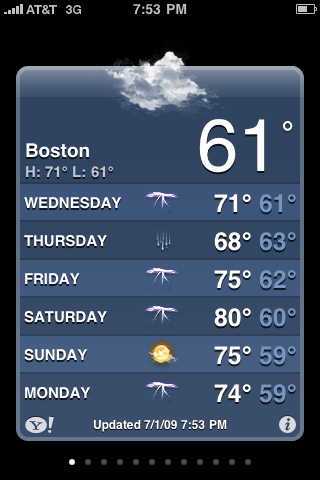
All anyone seems to be discussing here in Boston is how lousy the weather has been: overcast, wet, and gloomy. It’s the first thing that comes up in any conversation, whether it be at work, in casual chit-chat, or with loved ones. Nearly everybody agrees that the weather sucks.
Blakets of thick grey clouds have presided over skies during the month of June, already assuring us that at least a third of Boston’s brief, transitory summer will be without sun. For a city that lives and dies by the seasons, even the most hardened Bostonian is cursing the skies for the meteorological misfortune and pleading for more than just a short break to let the sun in.
The consistently lousy weather is cramping styles around here. Beach trips are being put off and otherwise vibrant neighborhoods are suffering because, really, who wants to frolic against a pallid background? Even local business are making the attempt to entice the area’s notoriously finicky shoppers to come out and buy, lowering their prices in an attempt to make it worth the effort. Yet, establishments who do most of their business indoors (and probably don’t rely on foot traffic) seem to find themselves with unseasonably good business. Something’s just not right.

The recently purchased bike (see photo above, far right) sits at the base of the stairwell, waiting to be used; but it’s not worth sullying the new wheels in the foul weather. As much as the machine is meant for commuting, I want to take a few joyrides first. At some point, the bici will get its time in the water, but not now. So as I walk, thunder rumbles overhead, constantly on the verge of freaking me out with the threat of a bolt slapping the ground nearby with a deafening crack. Recent developments only confirm that my fears are not unfounded.

With such a wet summer, it seems that Tlaloc has been vacationing in New England, with little intention of taking off anytime soon. All we can think of in light of all the rain is how Mexico City could sure use some of the water that’s getting dumped on Boston. It’s not fair for anyone, really.
Ya con la pinche lluvia!!!!
Filed under: Latinos, Music, Places to Go | Tags: DJing, Events, Music, Rare Grooves, Sound is Blog

Radio silence could best describe the recent state of affairs here at tirado/thrown headquarters. Your staff has been negligent in its thinking and typing duties, and instead brushing up on high school algebra, cramming vocabulary, and learning strategies to tackle the monster known as the Graduate Record Examination. All this preparation, of course, is in the service of mounting a pending graduate school application campaign in the fall.
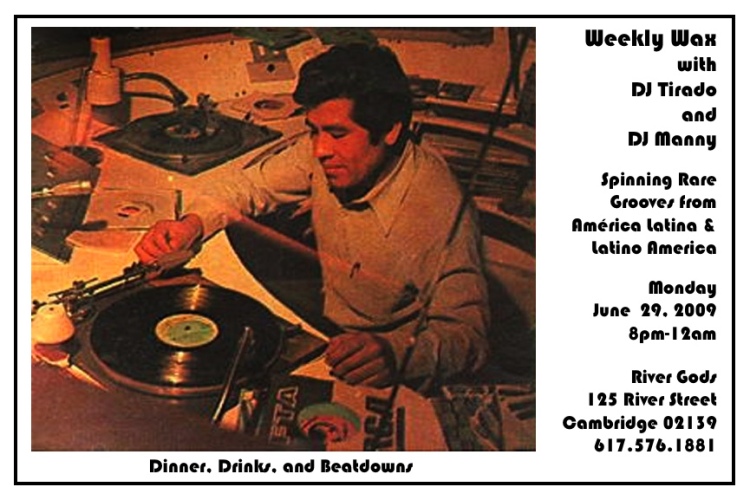
However, we’ve managed to cut through the thick wall of static generated by anxiety, study, exhaustion, and the repeated multiple choice questions to assemble some tracks and offer them up for the listening pleasure of the kind people who come to River Gods. On Monday June 29, as a part of the Weekly Wax series, DJ Tirado (yes, of this here tirado/thrown) will be teaming up with fellow traveler DJ Manny to showcase rolas from America Latina and Latino America spanning the decades. Inspired by the efforts of L.A.’s unparalleled Mas Exitos, we’ll be dispatching sounds like descargas, ballads, cumbias old and new, funk, psychedelic, and perhaps some electronic. All of it will come from Nuestra America.
Do come and join us for the dinner, drinks, and beatdowns that River Gods promises its patrons on Monday nights. The fare and the bar’s offerings are outstanding, and the locale is the perfect venue for a listening party. The sounds start at 8 p.m. and go on until midnight. Feel free to hit us up in the comments section for more information.
*Image: Hat tip to Joseph Franko at supersonido.net for the amazing pic. We couldn’t pass up using it for the flyer.
Filed under: Anthropology, Cultural Studies, L.A., Politics, Video | Tags: Anthropological Materialism, Crips and Bloods, Death and Life of American Cities, Documentary, Film, Gangs, Los Angeles, Marginal Affinities, Race, Stacy Peralta, Tribes
While caught onto relatively late here at tirado/thrown, we were moved by Baron Davis’s and Stacy Peralta’s astounding documentary Crips and Bloods: Made in America. What we first thought to be a historical reappraisal of urban unrest in Los Angeles unfolded into as comprehensive a survey of L.A. gang violence in South Central that a two-hour documentary could offer.
Immediately, the film took us back to the Los Angeles that we grew up beside and had a tangential relationship to: Sundays with family at the Slauson Swap Meet, occasional forays into South Central to visit friends, the sensationalized coverage of gang life that frightened the affluent but did not do any justice to the daily tales of suffering, tragedy, and strife in afflicted neighborhoods. The civil disturbances in 1992 in the wake of the Rodney King acquittals were pivotal events that could not escape the attention of any Angeleno living there at the time. Crips and Bloods captured the parts of the southland that at times felt so removed from the San Fernando Valley or even Hollywood.
Part of what makes this film noteworthy was that Peralta, the creator of Dogtown and Z-Boys and the Bones Brigade videos, stepped outside of making lifestyle films about surfing or skating to produce what is probably the most profound treatment on the creation of the most noted street gangs in contemporary American life.
Or is it that much of a stretch? If the 80s and 90s showed us anything, it was that gang bangers in the city and skater kids in the suburbs, beaches, and valleys were near-simultaneous occurrences of group cultures at the margins of institutional life: the family, education, workforce, church, and state. While the stakes of their activities could not be any more disparate, they would each have a profound impact on American cultural expression in late capitalism. **
Peralta’s documentary potently cites racism (institutional and otherwise), post-war demographic shifts, police brutality, economic stagnation, geographic isolation, and outright state repression as the sources of social arrangements that have wrought uncounted amounts of human tragedy.
The film’s most lucid insight grasped the relationship of gang violence to a hegemonic state, one where those who stand to most to lose from oppression perform the work of oppression, acting out and generating an exponentially vacuous cycle. Multiple commentators in the documentary noted how the disruption of community building and self-determination on the part of authorities, the introduction of a cheap and highly addictive narcotic, mass incarceration, and a social climate bereft of economic opportunity generated the perfect environment for a self-destruction that folded very readily with hegemony’s maintenance of social immobility. It performed a task more effectively than state repression was able to perform, since it did not require the National Guard to perform the violence it did in quelling the Watts rebellion. Bloods and Crips shows how these broader lines and vectors intersect in the existence of gang members themselves, their families, and community activists. It deftly demonstrates the human toll exacted by a complex interaction of personal actions, social situations, and psychological exigence.
Among the documentary’s most distressing scenes were aerial shots of the L.A. basin, with its districts, neighborhoods, and development tracts- not so much for the scattering and dispersion of peoples it implied, but for the way that those distributions of space resembled camps organizing life into some form. If anything, the helicopter shots give occasion to reflect on the thesis that the camp is the biopolitical law of modernity. They lead to ask how similar or different are cities than concentration camps? In certain parts of LA, simply responding the question of where one is from can easily be the cipher encoding one’s life or death.
Peralta’s film left us wondering, however: who will tell the stories of the Latino gangs that have developed since the 1930s? Who will tell of how clicks and maras such as 18th Street, White Fence, Florencia, and the Mara Salvatrucha were born and mutated in response to multiple waves of immigration, how they continue to be shaped by the forces of globalization and political upheaval in Mexico, Central America, and the United States? Such a sequel would be worth the wait.
**Strangely enough, The Serach for Animal Chin takes up as leitmotifs the creation narrative of skateboarding, its co-opting by commercial interests, and a marginalized community whose members are bound by their affinity for skateboarding’s originary ethos.
Filed under: Mexico, Philosophy, Politics | Tags: Agamben, Biopolitics, fascism, Health, Mexico, Security, State Power
The recent eruption of swine flu that ignited in Mexico has provoked a massive global response on the part of governments. In turn, it has prompted reflection here at tirado/thrown on biopolitics. The surrepetituiously unfolding events afforded an object lesson in how biopolitics, state power, government, and everyday life intersect. The phenomenon’s global scale makes this is an interesting case to examine how the administration of biopower effects social and political life.

Governments and public health ministries the world over are mobilizing at a frenzied clip. Mexico, Spain, the United States, New Zealand, Germany, China were at the vanguard of a growing list. At least in Mexico, the epidemiological situation was (and remains to be) treated as a state of exception. There, President Felipe Calderon issued a decree giving government expanded powers defined only by a vague reference to the epidemiological emergency. Surrounded by relativlely anodyne general public health policy directives, the decree’s second article grants the government powers to:
- isolate and limit the movements and activities of infected people,
- inspect passengers who “may be viral carriers”,
- enter “all type of place or dwelling house for the fulfillment of activities directed to controlling and combatting the epidemic”,
- regulate maritime, air, and ground transport, as well as giving government free use the means of transport and exchange, including, roads, telecommunications, and the mail.
Moreover, the terms of the decree are indefinite. The decree offers no criteria for defining what resolves the crisis other than a tautological one. That is, only the government could declare the crisis resolved, without stating (or even having to state) what a return to a non-exceptional situation would entail.
Legal scholar John Ackerman of Mexico City’s Universidad Autonoma Nacional de Mexico (UNAM) has already pointed out how the government of Felipe Calderon is resorting to the state of exception as an unconstitutional means to strengthen his grip on power and to extend his capacity to declare a state of emergency without legislative consent. Ackerman writes that “[Calderon's] response to the flu epidemic only exacerbates” the “authoritarian tendencies” he has shown in Mexico’s current campaign against the narcotics cartels.**
In the United States, the Department of Homeland Security (which controls immigration and customs agencies), the Department of Health and Human Services, and the Centers for Disease Control and Prevention have been at the forefront of the American response to the outbreaks, highlighting the biopolitical nexus between governmental power, national security, and public health. As of yet, no generalized state of emergency in the United States has been invoked for the government’s assumption of extraordinary powers.
In Mexico City, Daniel Hernandez notes how the drastic, seemingly sudden change in conditions has activated a generalized state of fear and suspicion that he describes thus:
…the fear is changing our lives in dramatic ways.
Mexico City prides itself on holding strongly to its social customs, despite the arrival of American-style Wal-Marts and Starbucks. But suddenly, Mass was canceled. Soccer matches were played to empty stadiums. Suddenly, the bars and clubs shut down. And suddenly, that warm customary greeting of a handshake and a kiss on the check was replaced with a friendly yet uneasy nod.
A culture built on physical contact has become a culture muted by fear, by suspicion, a distrust of others and even ourselves.
What has changed, and we will wait to find out how permanently, are the gestures which are our unmarketable political currency bearing the truth of our lives together. In their being gagged, arrested, and halted, we also notice how now (temporarily) absent gestures shaped a form of life, politics is now suspended by decree.
Just as interesting, and perhaps no less coincidental in this case, has been the general public response to the outbreak: the donning of surgical masks. While not an unusual device to use when airborne pathogens proliferate, the surgical masks’ rapid and widespread use alongside the state’s alacrity in regulating life on a mass scale for public safety gives an occasion to reflect on the ties binding a sovereign authority to the citizens it subjects to its power.

Masks render faces opaque and impenetrable. The swatches of sterile fabric covering the nose and mouth make expressions more inscrutable, more difficult to decode. They also inhibit the act of communication. Fear and distrust are further heightened by ambiguously peering eyes that show the absence of otherwise more full and radiant expressions. The masquerade seems to make our presence to each all the more obscure. In the manner of a photographic negative or an x-ray, the masks illuminate the how the faces they cover are the locus of the truth of ourselves. Giorgio Agamben notes in Means Without End,
Language…transforms nature into face… The face is at once the irreparable being-exposed of humans and the very opening in which they hide and stay hidden. The face is the only location of community, the only possible city. And that is because that which in single individuals opens up to the political is the tragicomedy of truth, in which they always already fall and out of which they have to find a way…
We may call tragicomedy of appearance the fact that the face uncovers only and precisely inasmuch as it hides, and hides to the extent to which it uncovers… Precisely because the face is solely the location of truth, it is also and immediately the location of simulation and of an irreducible impropriety. This does not mean, however, that appearance dissimulates what it uncovers by making it look lke what in reality it is not: rather, what human beings truly are is nothing other than this dissimuliation and this disquietude within the appearance…
State power today is no longer grounded on the monopoly of the legitimate use of violence…rather it is founded above all on the control of appearance (of doxa).
The state’s issuing of masks to cover faces becomes, then, an accidental, though no less important, metaphor for the glory of state’s reign: the de-politicization of citizens and the production of bare life by quaratine and separation. Gestures and faces alike are blocked; politics and truth are potentially suppressed, in part through the control of their appearances. These are among the political dimensions of the crisis worth adverting to.

Images: Felipe Calderon speaking at hospital opening, April 25, 2009, photo by Alfredo Guerrero, Latin American Herald Tribune; Our dear Citoyen du Monde riding the first wave out in DF; David De la Paz, Xinhua.
**tirado/thrown highly recommends the near-daily coverage of the swine flu crisis over at Daniel Hernandez’s blog, Intersections for reflections and analysis.